The Top 10 Types of Proxy Servers for Media Buying and Scraping in 2026
Discover the 10 essential types of proxy servers to boost your success. A complete guide to residential, datacenter, rotating, and elite proxies.
In the high-stakes worlds of media buying, ad verification, and large-scale data collection, the proxy server you choose isn't just a tool, it's the foundation of your entire operation. The difference between a high-trust residential IP and a flagged datacenter address can mean the difference between a successful campaign and a wasted budget. Yet, with a dizzying array of options from anonymous to elite and rotating to static, identifying the right tool for the job is a critical challenge. This comprehensive guide demystifies the landscape, breaking down the 10 essential types of proxy servers you need to understand.
We will move beyond simple definitions to explore the nuanced performance tradeoffs, security implications, and specific use cases that matter for performance-critical teams. You will learn the practical differences between a dedicated proxy for secure transactions and a rotating residential pool for massive-scale web scraping. Each section is structured to provide actionable insights into how these proxy variations directly impact operational success, from ensuring low-latency data access for quantitative trading to achieving unparalleled accuracy in ad verification.
Whether you're an agency aiming for 99.9% ad verification accuracy, a data scientist building a scalable collection pipeline, or a growth marketer managing complex affiliate campaigns, this guide will equip you with the knowledge to select the perfect proxy architecture. By the end, you'll be able to confidently evaluate and deploy the right proxies, ensuring your operations run with maximum speed, integrity, and efficiency.
1. Residential Proxy Servers
Among the various types of proxy servers, residential proxies are distinguished by their source: they use real IP addresses assigned by Internet Service Providers (ISPs) to actual residential homes. This architecture routes your web traffic through the device of a real homeowner, making your requests appear as though they originate from a legitimate, everyday internet user.
Because these IPs are tied to physical locations and have a history of genuine user activity, they carry an extremely high trust score with websites and ad platforms. This legitimacy makes them exceptionally difficult to detect and block, providing a significant advantage over IPs originating from data centers.
Use Cases and Applications
Residential proxies are the gold standard for operations where authenticity is non-negotiable.
- Ad Verification: Firms use them to accurately test ad delivery, ensuring ads are displayed correctly to specific geographic audiences without being served cloaked or fraudulent content.
- Media Buying: Agencies leverage residential IPs to manage multiple ad accounts on platforms like Facebook and Google, preventing account linkage and bans.
- Large-Scale Data Collection: Teams gathering consumer trend data or scraping e-commerce sites can bypass anti-bot measures that would otherwise block their requests.
- Market Research: Growth marketers can validate competitor ad placements and pricing strategies across diverse geographic markets with unparalleled accuracy.
Actionable Tips for Implementation
To maximize the effectiveness of residential proxies, a strategic approach is crucial.
- Rotate IPs Strategically: Implement intelligent IP rotation to mimic human behavior and avoid triggering rate limits or pattern-based detection.
- Use Sticky Sessions: For multi-step processes like completing a checkout or managing an account, use sticky sessions to maintain the same IP address for a set duration.
- Leverage Geo-Targeting: Filter your proxy pool by country, state, or even city to ensure your requests originate from the desired locale.
- Start Small and Validate: Before launching a large-scale campaign, test a small batch of IPs to validate their quality and performance against your specific targets.
- Monitor Performance: Proactively track success rates and response times. Reputable providers like ProxyPurpose Inc. offer dashboards to monitor IP health and replace underperforming assets.
2. Datacenter Proxy Servers
Contrasting with their residential counterparts, datacenter proxy servers are among the most common types of proxy servers, originating not from home internet connections but from powerful servers housed in commercial data centers. These IPs are artificially created and are not associated with an Internet Service Provider (ISP). This infrastructure allows them to offer immense speed, high uptime, and an abundance of available addresses at a lower cost.
Because datacenter proxies are generated in bulk and share subnets with other non-human traffic, they are more easily identified by sophisticated websites and anti-bot systems. While they lack the authenticity of residential IPs, their primary advantages are raw performance and cost-effectiveness, making them ideal for tasks where speed is paramount and detection risk is lower.
Use Cases and Applications
Datacenter proxies excel in scenarios demanding high throughput and low latency.
- High-Volume Data Scraping: Teams collecting public data from less-protected websites can leverage the speed of datacenter proxies to gather information rapidly.
- Performance Monitoring: Companies use them to monitor website uptime and load times from various global locations without the overhead of residential IPs.
- Low-Latency Market Data: Quantitative traders and High-Frequency Trading (HFT) firms rely on datacenter proxies for sub-millisecond routing to access time-sensitive market data.
- Internal Data Operations: Technology companies often use them for large-scale internal data ingestion and processing tasks where external IP reputation is not a concern.
Actionable Tips for Implementation
To get the most out of datacenter proxies, focus on performance and intelligent management.
- Reserve for Speed-Critical Tasks: Use datacenter proxies where speed is more critical than the IP's perceived authenticity, such as internal workloads or scraping less-guarded targets.
- Implement Request Throttling: Even with high speed, it's wise to implement gentle request throttling to avoid triggering basic rate-limiting rules on target servers.
- Monitor IP Reputation: Proactively check the reputation scores of your datacenter IPs. High-volume usage can get IPs flagged, so be prepared to rotate out underperforming addresses.
- Consider a Hybrid Strategy: Combine proxy types for optimal results. Use datacenter proxies for initial, high-speed data collection and switch to residential proxies for accessing protected endpoints or performing account management tasks.
- Optimize for Geo-Location: Select proxies from data centers located geographically close to your target servers to minimize latency and further enhance request speed.
3. Rotating Proxy Servers
Among the many types of proxy servers, rotating proxies offer a dynamic approach to IP management. Instead of assigning a single static IP address, this architecture automatically cycles through a large pool of different IPs, assigning a new one for each connection request or at predefined time intervals. This continuous rotation makes web requests appear as if they are coming from a multitude of different, unrelated users.
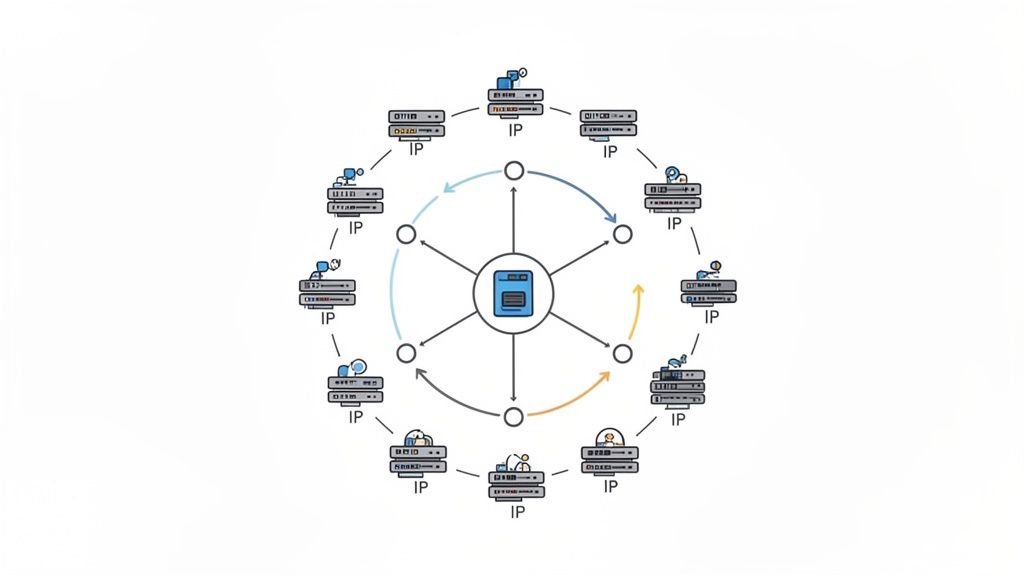
This mechanism is highly effective at evading detection and rate limits imposed by sophisticated websites and online platforms. By distributing requests across thousands or even millions of IPs, it becomes nearly impossible for target servers to identify and block the activity as originating from a single automated source, ensuring high success rates for large-scale operations.
Use Cases and Applications
Rotating proxies are indispensable for high-volume tasks where anonymity and persistence are critical.
- Large-Scale Data Collection: Data engineers gathering consumer sentiment or competitive intelligence can scrape thousands of pages without being blocked, ensuring comprehensive data sets.
- Ad Verification: Brand safety teams can test ad delivery across dozens of geographic markets simultaneously, verifying authenticity and proper placement for each unique impression.
- Media Buying: Agencies can run parallel verification checks on competitor ad placements or manage multiple accounts by making each action appear to originate from a distinct user.
- E-commerce Price Monitoring: Retail intelligence firms can track pricing and stock levels across competitor sites in real-time, avoiding IP-based blocks designed to stop such activity.
Actionable Tips for Implementation
To harness the full power of rotating proxies, precise configuration is key.
- Rotate Per-Request for Anonymity: For tasks like ad verification or scraping product pages, configure the proxy to change the IP address with every single request to maximize undetectability.
- Use Sticky Sessions for Continuity: When navigating multi-step processes like an online checkout, use "sticky" sessions to maintain the same IP for a few minutes to preserve session continuity.
- Implement Strategic Geo-Rotation: Align your IP rotation with your campaign's geographic targets. For example, cycle through IPs exclusively from specific cities or countries to validate localized content.
- Monitor Latency and Success Rates: Keep a close watch on rotation speed and request success rates. High latency can be a bottleneck for time-sensitive operations like quantitative trading.
- Log Rotated IPs: Maintain logs of all assigned IPs for auditing and troubleshooting purposes, allowing you to trace failed requests back to specific proxies in the pool.
4. Static Proxy Servers
In the diverse landscape of types of proxy servers, static proxies are defined by their persistence: they provide a single, unchanging IP address that remains constant for the user's session or an extended duration. This architecture provides stability and predictability, routing all requests from a specific task or account through one consistent IP address.
Unlike rotating proxies that cycle through IPs, a static IP builds a consistent identity over time. This is invaluable for activities where session continuity and maintaining a stable digital footprint are more important than mimicking the behavior of multiple distinct users. While they may have lower resistance to certain types of detection compared to rapidly rotating IPs, their predictability is a key operational advantage.
Use Cases and Applications
Static proxies are the preferred choice for tasks where a consistent, authenticated session is a requirement, not an option.
- Social Media Management: Agencies managing multiple client accounts on platforms like Instagram or Facebook use dedicated static IPs for each account to avoid triggering security alerts associated with frequent IP changes.
- E-commerce Account Management: Businesses handling seller accounts on platforms like Amazon or Shopify rely on static IPs to ensure consistent login credentials and prevent account holds or bans.
- Accessing IP-Whitelisted Services: Developers and data teams use them to access corporate networks, APIs, or databases that are firewalled to only allow connections from specific, pre-approved IP addresses.
- Online Banking and Financial Services: Users accessing sensitive financial accounts through a proxy often use a static IP to maintain a trusted session and avoid security-related lockouts.
Actionable Tips for Implementation
To leverage static proxies effectively, focus on maintaining IP health and session integrity.
- Assign One IP Per Account: Dedicate a unique static IP to each account you manage. This isolates the reputation of each account and prevents a problem with one from affecting others.
- Monitor IP Health: Proactively monitor the reputation score of your static IPs. If an IP gets flagged or its performance degrades, have a process ready to swap it for a fresh one.
- Warm Up New IPs: When introducing a new static IP to an account, start with low-volume, human-like activity before ramping up to full operational use. This helps build a trusted history.
- Combine with Moderate Throttling: Pair your static IP with reasonable request delays and throttling. A single IP sending requests too rapidly is an easy-to-spot red flag for anti-bot systems.
- Document Session Requirements: Before deploying, clearly document whether your target platform requires a persistent session. This validation ensures you are choosing the right tool and not using a static IP where a rotating one would be more effective.
5. Anonymous Proxy Servers
Positioned between transparent and elite proxies, anonymous proxy servers are a common choice among the various types of proxy servers. Their primary function is to conceal your original IP address from the destination server, but they do not hide the fact that a proxy is being used. These proxies achieve this by altering or removing identifying HTTP headers and replacing your real IP with their own.
However, they often add their own identifying headers, such as Via or X-Forwarded-For, which signals to the target website that the request is coming through a proxy intermediary. This provides a functional layer of privacy for your IP address without attempting to appear as a completely organic, non-proxied user, making them suitable for many general-purpose tasks.
Use Cases and Applications
Anonymous proxies are ideal for scenarios where concealing your IP address is the priority, but the detection of a proxy is not a significant concern.
- General Web Browsing: Individuals use them for privacy-conscious browsing, preventing websites from tracking their real IP address and location.
- Content Access: Users can bypass simple geo-restrictions on websites or streaming services where advanced proxy detection is not implemented.
- Brand Monitoring: Marketing teams can check public perception and monitor brand mentions on forums or social media without revealing their corporate identity.
- Basic SEO Research: SEO professionals use anonymous proxies to check search engine result page (SERP) variations from different regions without being blocked for automated queries.
Actionable Tips for Implementation
To effectively use anonymous proxies, you must understand their limitations and apply them strategically.
- Combine with Rate Limiting: Since the proxy's presence is known, implement strict request rate limits to avoid triggering anti-bot systems that flag high-volume traffic from a single IP.
- Monitor for Proxy-Detection Indicators: Actively check server responses for error codes or content changes that indicate the destination server has detected and is treating your traffic differently.
- Implement Header Filtering: If your proxy client allows, configure it to strip or modify headers like
Viato minimize the information revealing your proxy usage. - Use Exclusively with HTTPS: Always ensure traffic is encrypted via HTTPS. This prevents network intermediaries from inspecting the unencrypted headers that identify your proxy.
- Upgrade for Critical Operations: If a target system begins blocking your anonymous proxies, it's a clear signal to upgrade to elite or residential proxies for any mission-critical tasks.
6. Elite (High-Anonymity) Proxy Servers
Among the various types of proxy servers, elite proxies offer the highest level of anonymity by completely concealing both your original IP address and the fact that you are using a proxy. Unlike transparent or anonymous proxies, they do not pass any identifying HTTP headers, such as X-Forwarded-For or Via, to the destination server. This makes the proxy’s presence virtually undetectable, presenting your connection request as if it were coming directly from the client.

This level of stealth is crucial for operations where being identified as a proxy user would immediately lead to a block, captcha, or being served inaccurate data. By appearing as a genuine organic user, elite proxies can interact with the most sophisticated web platforms without raising suspicion, a capability pioneered by firms like Luminati (now Bright Data) and perfected by providers like ProxyPurpose Inc. who filter for and test this specific attribute.
Use Cases and Applications
Elite proxies are indispensable for tasks requiring absolute stealth and a legitimate user appearance.
- Ad Verification: Brand safety teams use elite proxies to test campaign delivery without ad platforms detecting their verification tools and altering the results.
- Media Buying: Agencies manage multiple social media and ad accounts, validating competitor campaigns and placements while avoiding account linkage and bans.
- Sensitive Data Collection: Researchers gathering user-generated content (UGC) or community data can operate at scale without being blocked by anti-scraping systems.
- Conversion Path Testing: Growth marketers test landing pages and checkout funnels from various geolocations, ensuring a genuine user experience is accurately reflected.
Actionable Tips for Implementation
To harness the full power of elite proxies, meticulous setup and management are key.
- Prioritize Elite Residential IPs: For critical media buying and ad verification tasks, combine the authenticity of a residential IP with the stealth of an elite configuration.
- Test Elite Status Continuously: Before deploying at scale, run tests against your specific target platforms to confirm the proxies maintain their elite status and are not flagged.
- Combine with Advanced Filtering: Enhance anonymity by layering elite proxies with additional filtering, such as Shield Protection, to preemptively block known threats and bot detectors.
- Monitor Proxy Health: Regularly check the reputation and performance of your elite proxy pool to ensure their high-anonymity status is maintained over time.
- Implement Smart Throttling: Despite being undetectable, high-volume requests can still trigger behavioral blocks. Throttle your requests to mimic human browsing patterns.
7. Reverse Proxy Servers
Unlike the other types of proxy servers that act on behalf of the client, reverse proxies operate on behalf of the web server. Positioned in front of one or more web servers, a reverse proxy intercepts requests from the internet and forwards them to the appropriate backend server. To the client, the reverse proxy appears to be the origin server itself, masking the complexity of the backend infrastructure.
<iframe width="560" height="315" src="https://www.youtube.com/embed/4NB0NDtOwIQ" frameborder="0" allow="accelerometer; autoplay; clipboard-write; encrypted-media; gyroscope; picture-in-picture" allowfullscreen></iframe>This server-side architecture is not designed for user anonymity but for enhancing the security, performance, and reliability of web applications. By centralizing request management, reverse proxies can distribute traffic, cache static content, and terminate SSL connections, significantly offloading work from backend servers.
Use Cases and Applications
Reverse proxies are a foundational component of modern web architecture, essential for scalability and resilience.
- Load Balancing: Enterprises like Netflix use reverse proxies (such as Nginx or HAProxy) to distribute billions of incoming user requests across vast farms of backend servers, ensuring no single server is overwhelmed.
- Content Delivery Networks (CDNs): Services like Cloudflare and Akamai act as a global network of reverse proxies, caching content at the edge to deliver it faster to users worldwide.
- API Gateways: In a microservices architecture, an API gateway (a specialized reverse proxy) routes client requests to the correct backend service, handles authentication, and enforces rate limiting.
- Web Application Security: A reverse proxy can function as a Web Application Firewall (WAF), inspecting incoming traffic to filter out malicious requests like SQL injection or cross-site scripting (XSS) before they reach the origin server.
Actionable Tips for Implementation
Proper configuration is key to unlocking the full potential of a reverse proxy.
- Deploy at the Network Edge: Place the reverse proxy as close to the end-user as possible (for example, in a CDN) to minimize latency and maximize performance gains from caching.
- Implement Robust Health Checks: Configure active health checks to constantly monitor the status of backend servers. This allows the proxy to automatically route traffic away from failed or unresponsive servers.
- Configure Strategic Caching: Use caching headers effectively to define which content is static and can be served directly from the proxy's cache, reducing load on origin servers and speeding up response times.
- Establish Redundancy: Avoid a single point of failure by deploying multiple reverse proxies in a high-availability cluster. This ensures continuous service even if one proxy instance goes down.
- Implement Rate Limiting: Protect backend services from DDoS attacks and abusive traffic by configuring rate limits at the reverse proxy layer, which can block or throttle excessive requests from a single IP.
8. Forward Proxy Servers
As one of the most fundamental types of proxy servers, a forward proxy acts as an intermediary on behalf of a client or a group of clients. It sits between the user and the wider internet, intercepting outgoing requests and forwarding them to their intended destination servers. This process effectively masks the client's original IP address, making the request appear to originate from the proxy server itself.
Unlike reverse proxies, which protect servers, forward proxies are client-centric, designed to provide privacy, security, and access control for the user. They are the standard mechanism used in most proxy applications, from corporate network security to large-scale data collection and ad verification operations.
Use Cases and Applications
Forward proxies are the workhorse for any operation that requires masking a client's identity or location.
- Ad Verification: Teams use forward proxies to test campaign delivery from multiple geographic locations, ensuring ads are displayed correctly and are not subject to cloaking.
- Corporate Security: Businesses deploy forward proxies to filter outbound web traffic, block malicious websites, and enforce acceptable use policies for employees.
- Market Research: Growth marketers leverage forward proxies to access geo-restricted content, analyze competitor pricing, and view localized search engine results.
- Data Collection: Engineers configure forward proxies to scrape publicly available information at scale while avoiding IP-based blocks and rate limits.
Actionable Tips for Implementation
To properly leverage forward proxies, a clear strategy is essential for both performance and anonymity.
- Select the Right IP Type: Choose the appropriate proxy IP source, such as residential or datacenter, based on your target's sensitivity and your project's authenticity requirements.
- Implement Intelligent Rotation: Use a proxy manager to rotate IPs automatically. This prevents a single IP from making too many requests, which can trigger anti-bot systems.
- Throttle Your Requests: Even when using a proxy, sending requests too quickly can appear as bot-like behavior. Implement delays between requests to mimic human browsing patterns.
- Test Before Full Deployment: Before launching a large-scale project, validate your forward proxy setup against your target platforms to confirm they are not blocked and perform as expected.
- Document Configurations: Maintain clear documentation of your proxy settings, including IP pools, rotation rules, and user-agent configurations, for auditing and compliance.
9. Dedicated Proxy Servers (Private Proxies)
Among the specialized types of proxy servers, dedicated proxies, also known as private proxies, are defined by their exclusivity. They provide an IP address assigned to a single user or organization, ensuring that no one else shares that address. This single-tenancy model delivers exceptional stability, consistent performance, and complete control over the IP's reputation, as your activities are the only ones influencing its history.
This architecture is the antithesis of shared proxies, where the actions of numerous unknown users can degrade an IP's trust score. With a dedicated proxy, you get a clean, predictable asset, ideal for long-term projects and sensitive operations where performance and reputation are paramount. It’s like owning a private road instead of sharing a congested public highway.
Use Cases and Applications
Dedicated proxies are the solution for missions that demand unwavering stability and reputation management.
- Premium Media Buying: Agencies use dedicated residential IPs from providers like ProxyPurpose Inc. to manage high-value ad accounts, ensuring reputation continuity and avoiding platform flags.
- Brand Safety Monitoring: Teams can monitor ad placements in specific geographic markets using exclusive IPs, guaranteeing that their monitoring tools are not blocked or served misleading content.
- High-Value Affiliate Marketing: Affiliates operating on networks with strict compliance rules leverage dedicated IPs to maintain a consistent, trustworthy digital identity.
- Low-Latency Trading: Quantitative traders rely on dedicated datacenter proxies for guaranteed low-latency connections to financial data feeds, where every millisecond counts.
Actionable Tips for Implementation
To get the most out of dedicated proxies, a disciplined management approach is required.
- Monitor IP Health and Reputation: Continuously track your dedicated IP's reputation score. If it drops significantly, have a process to rotate to a fresh dedicated IP.
- Reserve for High-Value Operations: Use dedicated proxies for your most critical, reputation-sensitive tasks. Consider a hybrid model: dedicated IPs for key accounts and rotating shared IPs for bulk data collection.
- Establish Consistent Request Patterns: To maintain a high trust score, ensure your request patterns appear natural and avoid erratic, high-volume bursts that could signal bot activity.
- Document All Usage: Keep meticulous records of which dedicated IP is used for which campaign or account. This is crucial for compliance, troubleshooting, and managing platform relationships.
- Leverage Uptime Guarantees: Select a provider that offers a Service Level Agreement (SLA). For example, using a proxy with a 99.9% uptime SLA ensures your mission-critical operations have guaranteed availability.
10. Shared Proxy Servers (Pooled Proxies)
Among the diverse types of proxy servers, shared proxies are defined by their multi-tenant architecture. These IPs are sourced from a large pool and are used simultaneously by multiple clients. This model significantly reduces costs by distributing bandwidth and infrastructure expenses across a wide user base, making it a highly economical option for various applications.
The primary trade-off with shared proxies is the lack of exclusive control. Since the IP addresses are used by others, one user's actions can impact the reputation and performance for everyone sharing that IP. This "noisy neighbor" effect makes them less suitable for operations where a pristine reputation is critical.
Use Cases and Applications
Shared proxies are a pragmatic choice for large-scale or budget-conscious tasks where individual IP reputation is not the highest priority.
- High-Volume Data Collection: Teams needing massive parallelism for web scraping can leverage large shared pools to distribute requests and manage costs effectively.
- Market Research: Analysts can monitor competitor pricing or consumer sentiment across various platforms where occasional blocks or captchas are an acceptable part of the workflow.
- Affiliate Marketing: Marketers testing numerous ad campaigns with tight budgets can use shared proxies to check landing pages and offers across different geos without a large initial investment.
- Initial Project Scoping: Startups and developers can use shared proxies for exploratory data gathering or to validate a proof-of-concept before committing to more expensive dedicated resources.
Actionable Tips for Implementation
To get the most value from shared proxies, you must actively manage their inherent volatility and build resilience into your operations.
- Implement Aggressive Monitoring: Continuously track the health and reputation of your shared IP pool. Be prepared to quickly discard and replace IPs that become flagged or demonstrate high failure rates.
- Build Robust Retry Logic: Since shared IPs are more prone to blocks, design your applications with sophisticated retry mechanisms that automatically re-queue failed requests with a new IP.
- Combine with Smart Rotation: Use a proxy management solution to intelligently rotate through your shared pool, maximizing the diversity of available IPs and minimizing the footprint from any single address.
- Isolate Critical Tasks: Use shared proxies for exploratory or bulk data collection but reserve dedicated or residential proxies for high-value operations like account management or checkout processes.
- Throttle Your Requests: To avoid contributing to an IP getting banned, implement reasonable delays and throttling on your requests to mimic more human-like behavior and reduce server load.
Comparison of 10 Proxy Server Types
| Proxy Type | Implementation complexity 🔄 | Resource requirements ⚡ | Expected outcomes ⭐ | Ideal use cases 📊 | Key advantages 💡 |
|---|---|---|---|---|---|
| Residential Proxy Servers | Moderate — provider integration, rotation management | High cost; moderate latency; geo-distributed IP pools | High legitimacy and low blocking (⭐⭐⭐) | Ad verification, media buying, geo-targeted data collection | Real ISP IPs; minimal blocking; accurate geolocation |
| Datacenter Proxy Servers | Low — simple deployment and config | Low cost; high bandwidth; very low latency | High throughput but higher detection risk (⭐⭐) | Low-latency trading, large-scale scraping, internal ingestion | Fast, cost-effective, predictable performance |
| Rotating Proxy Servers | High — rotation policies and pool management | Moderate–high (large IP pools, monitoring) | Reduces detection; scalable request volume (⭐⭐⭐) | Large-scale data collection, multi-impression ad verification | Per-request IP rotation; avoids IP burnout; multi-market ops |
| Static Proxy Servers | Low — persistent IP assignment, simpler ops | Moderate (single IP per session; less pool management) | Session continuity; higher detection with volume (⭐⭐) | Authenticated flows, account-based verification, stable sessions | Stable identity persistence; predictable behavior |
| Anonymous Proxy Servers | Low — basic anonymization and header handling | Low cost; moderate bandwidth | Hides client IP but reveals proxy use (⭐⭐) | General privacy browsing, non-critical data collection, region checks | Privacy at low cost; better than transparent proxies |
| Elite (High-Anonymity) Proxy Servers | High — ensure no proxy headers, strict quality checks | High cost; careful IP reputation management | Strong invisibility; best bypass rates (⭐⭐⭐) | Sensitive ad verification, media buying, stealth data collection | No proxy headers; appears as genuine user; highest success |
| Reverse Proxy Servers | High — server-side deployment, redundancy planning | High infrastructure and ops requirements | Improves origin performance, security, and scalability (⭐⭐⭐) | CDNs, load balancing, API gateways, SSL termination | Caching, load distribution, security layer for origins |
| Forward Proxy Servers | Low — client-side deployment and configuration | Variable (depends on residential vs datacenter choice) | Masks client IP; detection depends on proxy type (⭐⭐) | Client anonymity, ad verification, geo-unblocking, scraping | Client-side anonymity, header manipulation, geo-spoofing |
| Dedicated Proxy Servers (Private) | Moderate — provisioning and monitoring per client | High cost; exclusive IPs; SLA-backed resources | Stable reputation and predictable results (⭐⭐⭐) | Brand safety, premium campaigns, traders requiring consistency | Exclusive control of IP reputation; reliable performance and support |
| Shared Proxy Servers (Pooled) | Low — quick access to shared pools | Low cost; shared bandwidth; high scalability | Economical but variable performance and reputation (⭐) | High-volume non-critical scraping, startups, exploratory work | Lowest cost per request; rapid scaling and broad geo diversity |
From Theory to Action: Building Your Optimal Proxy Strategy
We've navigated the intricate landscape of proxy servers, moving from foundational concepts like forward and reverse proxies to the granular specifics of residential, datacenter, and mobile IPs. The journey through the different types of proxy servers reveals a critical truth: the era of the one-size-fits-all proxy solution is over. Choosing the right proxy is no longer a simple technical decision; it's a strategic imperative that directly impacts data accuracy, operational efficiency, and competitive advantage.
A superficial understanding leads to costly mistakes, such as using slow, easily detectable datacenter proxies for sophisticated web scraping or employing shared proxies for sensitive ad verification tasks. The key takeaway is that your use case must dictate your proxy architecture, not the other way around. Every proxy type represents a unique combination of speed, anonymity, cost, and trustworthiness.
Synthesizing Your Proxy Blueprint
To translate this knowledge into a functional strategy, you must move beyond simply knowing the definitions and focus on the operational trade-offs. The choice between a static residential IP and a rotating datacenter pool, for example, has profound implications. One offers stability and a high trust score for managing sensitive accounts, while the other provides speed and scale for high-volume, low-sensitivity data collection.
Consider these core principles as you build your strategy:
- Match Anonymity to Risk: For ad verification, brand safety, and competitive intelligence, the goal is to mimic a real user flawlessly. This requires the highest level of anonymity, making elite residential proxies non-negotiable. Using a lower-tier proxy risks detection, which invalidates your data and compromises your mission.
- Align Performance with Urgency: Quantitative trading and real-time market data analysis demand the lowest possible latency. Here, proximity-optimized datacenter proxies are the only viable option. Sacrificing milliseconds of speed for a higher anonymity level that isn't required is a strategic error.
- Balance Scale with IP Reputation: Large-scale web scraping for market research or SEO analytics requires a vast, diverse pool of IPs to avoid rate limiting and blocks. An intelligent rotating residential proxy network is ideal, as it distributes requests across thousands of clean IPs, making your activity appear organic and difficult to track.
Key Insight: The most advanced proxy strategies are not static. They are dynamic, often employing a hybrid model. A media buying agency might use dedicated residential proxies for managing high-value ad accounts while simultaneously using rotating datacenter proxies for scraping competitor landing pages for quick analysis.
The True Value of a Purpose-Built Proxy Solution
Mastering the various types of proxy servers empowers you to architect a system that is resilient, efficient, and precisely aligned with your business objectives. For a growth marketer, this means gathering clean, geo-specific data to optimize campaigns. For a data engineer, it means ensuring the integrity and reliability of a massive data pipeline. For a quantitative trader, it means executing trades based on accurate, real-time information.
Ultimately, the right proxy infrastructure is an investment that pays dividends in the form of higher data accuracy, reduced operational friction, and the ability to scale complex online operations with confidence. By moving away from generic, commoditized proxy pools and toward a specialized, performance-oriented solution, you transform your proxy from a simple tool into a powerful engine for growth and innovation. The knowledge you've gained from this guide is your first step toward building that engine.
Ready to move beyond generic proxy pools and implement a strategy built for performance and reliability? ProxyPurpose Inc. provides specialized, high-trust residential and datacenter proxies engineered for demanding use cases like ad verification, large-scale data collection, and media buying. Explore our purpose-built proxy solutions and see how a tailored approach can elevate your operations at ProxyPurpose Inc..