The Ultimate Guide to Proxy IP Rotation
Master proxy IP rotation with our definitive guide. Learn proven strategies to avoid blocks, scale web scraping, and improve ad verification for your business.
At its core, proxy IP rotation is simply the process of automatically swapping out your IP address from a large pool of proxies. You can do this for every single connection you make or change it up at specific time intervals.
This isn't just a technical trick; it’s a strategic way to make your web requests look like they're coming from hundreds or even thousands of different, real users. For anyone doing large-scale online work, this is an absolute game-changer for avoiding detection and blocks.
Unlocking Scale with Proxy IP Rotation
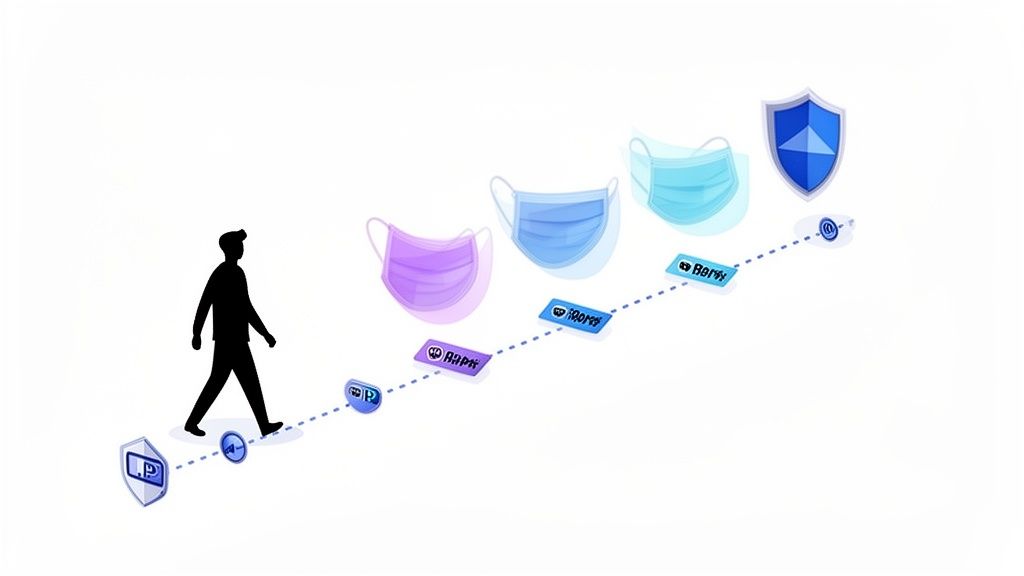
Think of your IP address as your computer's license plate. If you send thousands of requests to a website from one static IP, it’s like the same car circling the block a thousand times in an hour. That kind of behavior looks incredibly suspicious and is an easy way to get flagged by security systems, leading to frustrating IP blocks, rate limits, and endless CAPTCHA puzzles.
Proxy IP rotation solves this by giving you a fresh "license plate" for each task. Instead of one car doing endless loops, the website now sees a thousand different cars arriving from all over the place. This looks far more like organic user traffic, letting your operations run smoothly without getting shut down.
Why Rotation Is a Strategic Advantage
This is a fundamental requirement for any serious media buying, ad verification, or data collection effort. Without a solid proxy ip rotation strategy, your projects are sitting ducks, vulnerable to constant disruptions that can wreck your data's integrity and burn through your budget.
The benefits are pretty clear:
- Bypassing IP Bans: By spreading requests across a huge pool of IPs, no single address ever racks up enough activity to get flagged.
- Avoiding Rate Limits: Many sites cap the number of requests an IP can make. Rotation makes those limits practically irrelevant.
- Overcoming Geo-Restrictions: Need to check out content or verify ads in a specific country? Just rotate through IPs located in that region. It’s that simple.
To put this into perspective, let's look at some of the common headaches that IP rotation directly addresses.
Key Problems Solved by Proxy IP Rotation
This table breaks down the main challenges that businesses face and how a good rotation strategy tackles them head-on.
| Challenge | How IP Rotation Solves It | Business Impact |
|---|---|---|
| IP Blocks & Blacklisting | Distributes requests across a massive pool of IPs, preventing any single address from being flagged for overuse. | Prevents operational downtime, ensures continuous data collection, and protects project timelines. |
| Rate Limiting | Continuously changes the source IP, so automated tasks never hit the request-per-minute caps set for a single user. | Allows for higher request volumes, accelerating data gathering and campaign verification tasks. |
| CAPTCHA Challenges | Mimics organic, human-like traffic patterns, reducing the likelihood of triggering security measures designed to stop bots. | Minimizes manual intervention, saves time and resources, and improves the overall efficiency of automated workflows. |
| Geo-Restrictions | Uses proxies from specific geographic locations to make requests appear as if they originate from that country or city. | Enables accurate ad verification, market research, and content access for global campaigns without physical presence. |
As you can see, these aren't minor technical fixes—they're solutions to major business obstacles that can stop a project in its tracks.
The market size backs this up. The Rotating Proxy Service Market for residential proxies was valued at $2,014.9 million in 2022 and is expected to balloon to $16,337.5 million by 2030. That growth is fueled by critical needs in ad verification and price scraping—fields where static IPs get blacklisted in a heartbeat. You can explore more data on this market trend to see just how essential this has become.
In essence, proxy IP rotation is the engine that enables scale. It transforms a high-risk, easily blocked operation into a resilient, efficient workflow that can handle the demands of modern data-driven business.
When you can make your automated tasks appear as countless distinct users, you can gather information, verify ad placements, and run campaigns with a much higher chance of success. It's all about ensuring the data you collect is clean and your operational investments are protected.
Choosing Your IP Rotation Strategy
Picking the right IP rotation strategy is a lot like choosing the right tool for a job. You wouldn't use a sledgehammer to hang a picture frame, right? In the same way, how you rotate your IPs has to match what you’re trying to accomplish. A one-size-fits-all approach is a recipe for getting blocked.
Not all rotation methods are built the same. The best strategy really boils down to your mission, whether you're scraping thousands of pages anonymously or trying to mimic a real user's multi-step journey on a website. Getting a handle on the core methods is the first step toward building a data operation that actually works.
We can break it down into three main strategies, each designed for a different purpose. By matching your task to the right rotation method—per-request, sticky sessions, or a high-rotation pool—you avoid the common pitfalls that trip up even experienced teams.
Per-Request Rotation: The Anonymous Workhorse
Imagine you need to check the prices of 10,000 different products on a massive e-commerce site. Each price check is a quick, one-off action. For this kind of high-volume, anonymous work, per-request rotation is your absolute best friend.
With this strategy, every single request you send cycles to a brand-new IP address. The first request goes out from IP A, the second from IP B, the third from IP C, and so on. This constant shuffling makes it nearly impossible for a target server to connect the dots and realize all that activity is coming from a single source. To them, it just looks like thousands of different visitors.
- Best For: Large-scale data scraping, price aggregation, and SEO keyword monitoring.
- Key Advantage: Maximum anonymity. This drastically lowers your chances of getting rate-limited or blocked when you’re sending a ton of requests.
- Example: A travel aggregator scraping flight prices from dozens of airline websites would lean heavily on per-request rotation to stay under the radar.
This rapid-fire IP switching is the backbone of modern data collection. It’s a massive operation globally—proxy networks enable over 9 million IP rotations daily across 95 countries. Just looking at residential proxies, you have 5.5 million IPs rotating 1.2 billion times a day to keep these operations running smoothly. You can discover more insights about the proxy service market to see the sheer scale of it all.
Sticky Sessions: For Multi-Step Journeys
Now, let's flip the script. Instead of quick hits, you're an ad verification specialist testing a user journey. You need to click an ad, land on a product page, add something to the cart, and go through a multi-page checkout. If your IP address changed with every click, the website would get confused, see you as a new person at each step, and your session would break.
This is exactly where sticky sessions come in. This strategy gives you one IP address and holds onto it for a set amount of time—maybe 5, 10, or 30 minutes. It lets you complete a whole sequence of actions just like a real person would, maintaining a consistent presence.
A sticky session is all about consistency. It creates a stable digital identity for the duration of a specific workflow, which is absolutely essential for any task that needs session integrity and a continuous user history.
Think of it as keeping the same disguise on until the mission is complete. This method is crucial for:
- E-commerce Checkouts: Moving from the shopping cart to the payment page without being logged out.
- Ad Verification: Following the entire journey from an ad click to a successful conversion.
- Social Media Management: Logging into an account and performing actions without triggering security flags.
High-Rotation Pools: The Balanced Approach
Sometimes, you need something in the middle. Maybe your task doesn't demand a new IP for every single request, but a 30-minute sticky session is overkill and might raise suspicion. This is where a high-rotation pool offers a smart, balanced solution. It changes your IP every few minutes or after a set number of requests.
This strategy works beautifully for tasks with moderate interaction, where you need to look like a consistent user for a short while before switching identities. It blends the anonymity of frequent changes with just enough persistence to get through short workflows, making it a super flexible option.
To make it even clearer, here’s a quick breakdown of how these strategies stack up against one another.
Comparison of IP Rotation Strategies
| Strategy | Best For | Pros | Cons |
|---|---|---|---|
| Per-Request Rotation | High-volume, anonymous scraping (e.g., price aggregation, SEO data). | - Maximum anonymity<br>- Very hard to detect and block<br>- Ideal for parallel requests | - Breaks multi-step processes<br>- Can't maintain user sessions |
| Sticky Sessions | Multi-step user journeys (e.g., checkouts, account management, ad verification). | - Maintains session integrity<br>- Mimics real user behavior<br>- Essential for stateful interactions | - Higher risk of detection if session is too long<br>- A single IP block can disrupt the entire workflow |
| High-Rotation Pool | Tasks needing a balance (e.g., browsing multiple pages on one site, short workflows). | - More anonymous than long sticky sessions<br>- More persistent than per-request<br>- Flexible and adaptable | - Can still break longer, complex sessions<br>- Less anonymous than per-request |
Choosing the right one really comes down to understanding the nature of your target and the goals of your project. There's no single "best" strategy—only the one that’s best for your specific use case.
2. Selecting the Right Proxies for Rotation
Your whole IP rotation strategy lives or dies by the quality of the IPs you use. Picking the right proxy type is a fundamental choice that directly shapes your success rate, your budget, and whether you fly under the radar or get spotted immediately. Not all proxies are built the same, and knowing where they come from is the key.
Think of it like choosing a vehicle for a covert mission. You could show up in a flashy, custom-built sports car that screams for attention, or you could arrive in a regular family sedan that just melts into the background. In the proxy world, datacenter IPs are that flashy car, while residential IPs are the everyday vehicle that nobody looks at twice.
Datacenter IPs: Fast but Flawed
Datacenter IPs are the most widely available and cheapest option out there. They're created in huge batches by cloud providers and live on servers in commercial datacenters. While they're undeniably fast and easy to get, they have a massive, glaring weakness: their origin is a dead giveaway.
Sophisticated anti-bot systems can easily spot and blacklist entire IP blocks belonging to datacenters. For simple, low-stakes tasks on less protected sites, they might do the trick. But for anything serious, like ad verification or scraping competitor data, using datacenter IPs is like shouting your intentions through a bullhorn. You’re going to get blocked, and you're going to get blocked fast.
Residential IPs: The Gold Standard
For any operation that matters, residential IPs are the go-to solution. These are real IP addresses assigned by Internet Service Providers (ISPs) to actual homes. When you route your traffic through a residential proxy, your requests look like they’re coming from a regular person browsing the internet from their living room. That legitimacy is their secret weapon.
This authenticity makes it incredibly risky for websites to block them—they might end up blocking real customers. For tasks that demand a high trust score and uninterrupted access, like navigating complex checkout flows or gathering product data from major e-commerce sites, residential proxies are absolutely essential. They are the bedrock of any effective proxy ip rotation system.
The demand for this kind of authentic traffic is fueling incredible growth. The Dynamic IP Proxy Service Market is expected to jump from $1.5 billion in 2024 to $3.8 billion by 2032, with residential proxies paving the way. In North America alone, there are over 19 million residential IPs available, which are critical for ad verification and brand protection efforts that rely on mimicking genuine user behavior. You can dive deeper into these market dynamics and growth drivers.
Mobile IPs: The Premium Choice
Finally, Mobile IPs sit at the very top of the proxy pyramid. These are IPs assigned to mobile devices by cellular carriers like Verizon or T-Mobile. Since so much of today's web traffic comes from smartphones, requests from mobile IPs are given the highest level of trust, especially on mobile-centric platforms like Instagram or TikTok.
A clean, high-quality proxy pool isn't an expense—it's a direct investment in your project's success. A better pool means fewer bans, more reliable data, and a much higher ROI.
To help you match the right rotation strategy with your chosen proxy type, the flowchart below maps out the decision based on what you’re trying to accomplish.
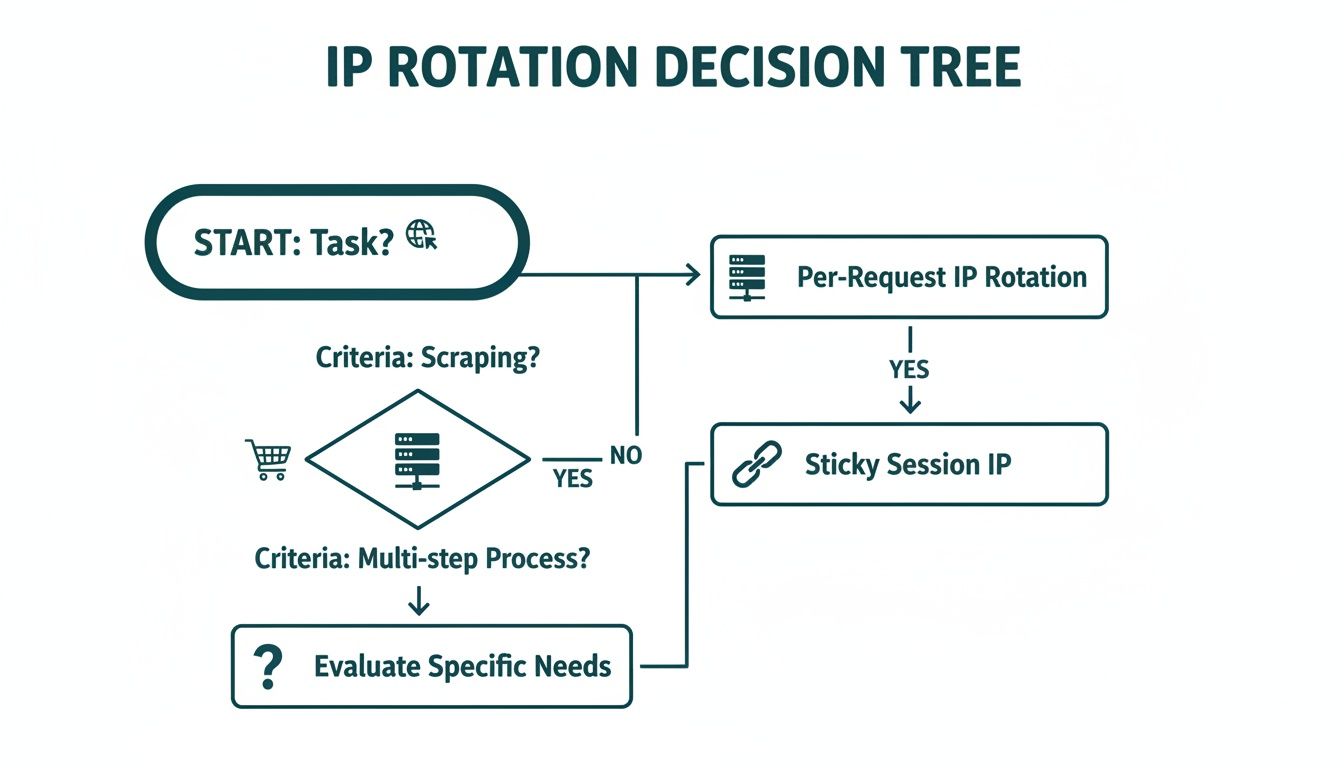
As you can see, simple, one-off tasks like scraping search results are perfect for per-request rotation. On the other hand, multi-step processes like managing a social media account absolutely need the consistency of a sticky session. In the end, pairing the right proxy with the right rotation strategy is what separates a smooth, successful operation from a frustrating, block-filled nightmare.
Nailing the Execution of Your Rotation Strategy
A great strategy is just a plan on paper until you execute it. This is where the rubber meets the road, and even the best-laid plans can fall apart if you ignore the small, yet critical, operational details. Think of this section as your field guide to making sure every request you send has the best possible shot at success.
It all boils down to looking human. Websites today are sophisticated; they don't just look at your IP. They scrutinize your entire digital fingerprint—browser headers, cookies, and even the rhythm of your requests. Getting these details right is the difference between flying under the radar and getting shut down fast.
Keep Your Headers and Cookies Straight
Your headers and cookies are like a digital passport. The User-Agent header, for example, tells a website what kind of browser and OS you're using. Sending a flurry of requests from one IP address but with a hundred different User-Agents is an immediate giveaway that something is off. You need to build and maintain a believable, consistent profile for each identity.
Cookies are just as important, especially for sticky sessions. They're how a site remembers you between clicks. If your IP address stays the same but your cookies disappear with every new request, the server knows you're not a real person browsing their site. Proper cookie management—storing and reusing them correctly for each session—is non-negotiable for creating a realistic user journey.
A successful proxy operation isn't just about changing your IP address. It's about meticulously crafting a consistent digital identity—from headers to cookies—that appears completely natural to sophisticated anti-bot systems.
This kind of consistency is what makes your automated activity look just like a real visitor's.
Set Realistic Concurrency Limits
One of the quickest ways to burn through your proxy pool and get banned is to slam a target server with too many requests at once. Concurrency is simply the number of connections you have open at the same time. It's tempting to crank it up to get the job done faster, but no human user opens 200 tabs on the same website in a single second. That kind of behavior screams "bot."
The trick is to find a sweet spot. Start with a low concurrency limit, maybe 5-10 simultaneous requests, and keep a close eye on your success rate. If everything looks good and you aren't hitting blocks, you can slowly dial it up. This cautious approach prevents you from wasting valuable residential IPs and keeps your operation running smoothly for the long haul.
A few tips for managing concurrency:
- Start Low, Go Slow: Always begin with a conservative number of parallel connections and increase it methodically.
- Watch for Errors: If you suddenly see a spike in blocks or error codes, your concurrency is too high. Back it down.
- Spread the Load: If you're working with multiple sites, distribute your requests across them instead of focusing all your traffic on one.
Find the Right Rotation Cadence
The final piece is timing. How often should you actually switch IPs? The answer really depends on your goal. If you’re scraping data with a per-request strategy, the rotation is constant—a new IP for every single connection.
For sticky sessions, however, timing is everything. Rotate too quickly, and you’ll break processes that require multiple steps, like completing a checkout. Wait too long, and a single IP might rack up enough activity to get flagged. For things like ad verification or navigating an e-commerce site, a session length between 5 to 15 minutes is a solid starting point.
It’s also smart to build a backoff mechanism into your code. If a request fails or gets hit with a CAPTCHA, your system should automatically pause and give that IP a "cooling off" period before trying again. This mimics how a real person would behave and stops you from repeatedly hitting a brick wall, which ultimately improves your success rate and protects the health of your proxy pool.
Putting Advanced Rotation into Practice with ProxyPurpose
<iframe width="100%" style="aspect-ratio: 16 / 9;" src="https://www.youtube.com/embed/DcIi-XPqmTQ" frameborder="0" allow="autoplay; encrypted-media" allowfullscreen></iframe>It's one thing to talk theory, but seeing a powerful proxy IP rotation system in action is where it all clicks. This is where we bridge the gap between concepts like sticky sessions and high-rotation pools and the real-world tools that make them happen. With ProxyPurpose, setting up these sophisticated strategies isn't a coding nightmare—it's just a matter of smart configuration.
Let's walk through how to turn your operational goals into a high-octane proxy setup. I'll show you how our purpose-built features solve common problems in ad verification and competitive intelligence, turning abstract ideas into tangible results. This is where your strategy gets real.
Setting Up a Sticky Session for Ad Verification
Let's say you're running an ad verification campaign. Your mission is to mimic a real user's journey: click an ad, explore the landing page, maybe browse for a few minutes, add an item to the cart, and head to checkout. This entire flow has to look seamless. If your IP address changes with every click, the server gets suspicious, the session breaks, and your verification fails.
This is a textbook case for a sticky session using our dedicated residential IPs.
- The Goal: Hold onto the same IP address for a 10-minute window to complete a full conversion path without raising flags.
- The Tool: Dedicated residential IPs, because they have the high trust score needed to look like a genuine home internet user.
- The Setup: You simply configure your proxy to maintain the same IP for a specific time. This ensures every action in that window comes from the same source, perfectly mimicking how a real person would browse.
Here’s a quick look at what a configuration snippet looks like. Notice the session-based parameters—that's the magic right there.
Example Python requests setup for a sticky session
proxies = { "http": "http://user-USERNAME-session-RANDOM_STRING:PASSWORD@gate.proxypurpose.io:7000", "https" : "https://user-USERNAME-session-RANDOM_STRING:PASSWORD@gate.proxypurpose.io:7000", }
All requests using this proxy configuration will maintain the same IP
response = requests.get("https://example-ad-network.com/verify", proxies=proxies)
This simple setup tells our system to assign you an IP and stick with it, making your entire workflow appear as a single, coherent user session. That's absolutely critical for getting accurate verification data.
High-Rotation Scraping for Price Intelligence
Now, let's flip the script. Imagine you need to scrape thousands of product prices from a huge e-commerce site. Here, a consistent session is the last thing you want. You need to be a ghost, making every request look like it’s from a brand-new visitor to fly under the radar of rate limiters and IP blocks.
This job calls for a high-rotation, per-request strategy, and our system makes it incredibly simple.
By simply removing the session parameter from your connection string, you instantly switch from a stable, sticky IP to a dynamic, per-request rotation. The infrastructure handles the complexity, giving you a fresh IP for every single request.
This is the go-to approach for any large-scale data collection where speed and volume are everything. Each connection dips into our massive pool of clean residential IPs, making your scraper look less like a single bot and more like organic traffic from thousands of unique shoppers.
The Power of Smart Routing and Shield Protection
A solid proxy IP rotation strategy is the foundation, but the real magic happens with the intelligence working behind the scenes. Two of our core features, Smart Routing and Shield Protection, give you a serious edge without you having to lift a finger.
Smart Routing is our automated traffic optimizer. It’s constantly analyzing network performance to find the fastest, most reliable path for every request you make. This completely removes the headache of manually testing proxy locations to find the one with the lowest latency. It just works, making sure your data collection runs as fast as humanly possible.
Shield Protection is your built-in security detail. It works hand-in-hand with rotation to plug common detection holes. It actively blocks browser fingerprinting scripts and prevents DNS leaks—two of the sneakiest ways anti-bot systems identify you even when your IP is clean. This layered defense keeps you anonymous and dramatically increases your success rates.
When you combine these intelligent features with the right rotation strategy, you're no longer just switching IPs. You're running a resilient, efficient, and incredibly effective operation built to get the job done.
Monitoring and Troubleshooting Your Setup
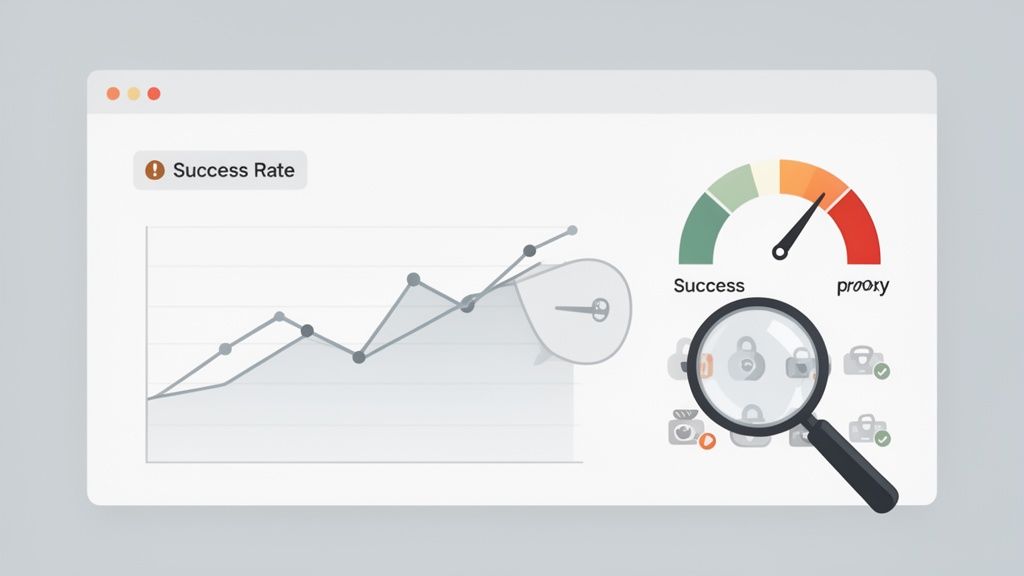
Here’s a hard truth: a proxy rotation system is never a "set it and forget it" machine. It’s more like a high-performance engine that needs constant tuning to run at its best. Just getting your operation up and running is only half the job. The real secret to consistent success lies in smart, proactive monitoring and quick troubleshooting.
Without a good view of what's happening under the hood, you’re essentially flying blind. You have no way of knowing if your rotation strategy is actually working, if a chunk of your proxies just went bad, or if a target site suddenly beefed up its security. Think of your monitoring dashboard as your command center—it’s where you get the intel to make sharp decisions and keep everything running smoothly.
Key Performance Metrics to Watch
To keep that engine humming, you need to keep a close eye on the gauges. These are the core metrics that will give you a real-time picture of your operational health.
-
Success Rate: This is your north star. It’s simply the percentage of requests that get a successful response (like a 200 OK) versus those that fail (like a 403 Forbidden or 503 Service Unavailable). If you can keep this consistently above 90-95%, you're in great shape.
-
Response Latency: How fast are you getting data back? High latency can kill your momentum, slowing down the entire operation. By tracking the average time it takes for a server to respond, you can quickly sniff out sluggish proxies or network clogs before they turn into major bottlenecks.
-
Block and CAPTCHA Frequency: Start counting every time you get blocked or hit with a CAPTCHA. A sudden jump in these numbers is a massive red flag. It’s the clearest sign that your current strategy has been figured out, and it’s time to switch things up.
Monitoring isn't just about catching failures; it's about optimizing for success. A low latency and high success rate directly translate to faster data collection and a better return on your proxy investment.
Once you start tracking these numbers, you’ll establish a performance baseline. The next time things go sideways, you'll have the data to diagnose the problem instead of just guessing in the dark.
A Practical Troubleshooting Checklist
When your success rate takes a nosedive, don't panic. Just work your way through this checklist to methodically track down and solve the most common culprits.
-
Isolate the Problematic Proxies: Are most of the failures coming from a specific country or a small batch of IPs in your pool? Often, a handful of "burned" proxies are responsible for the majority of errors. The first step is to find them, pull them from your rotation, and see if performance bounces back.
-
Adjust Your Rotation Frequency: If you’re using sticky sessions, maybe they're lasting too long and getting your IPs flagged. Try dialing the session time back from 10 minutes to 5. On the flip side, if you're rotating on every single request and getting blocked, try adding small, random delays between requests to look less like a bot.
-
Review Your Headers and Fingerprint: When was the last time you checked your User-Agent strings? Make sure they are diverse and look like legitimate, common browser profiles. A smart system like ProxyPurpose's Shield Protection can be a lifesaver here, as it automatically juggles these details to help you avoid fingerprinting.
-
Check the Target Site's
robots.txt: Don't forget the simple stuff. Websites update their rules all the time. A quick look at the target'srobots.txtfile might show new crawling restrictions that are causing your requests to fail. Playing by their rules is key to staying in the game for the long haul.
By making this kind of proactive monitoring and troubleshooting part of your regular routine, you can turn your proxy ip rotation setup from a fragile tool into a resilient, high-performance workhorse.
Questions We Hear All the Time About IP Rotation
After helping countless teams dial in their proxy setups, we've noticed a few questions pop up again and again. Here are the straight answers to the most common queries we get about IP rotation, designed to help you sharpen your own strategy.
How Often Should I Actually Rotate My IP Address?
Honestly, there's no magic number. The right rotation speed is completely tied to what you're trying to accomplish.
For massive public data gathering, like scraping thousands of product pages, rotating on every single request is usually the way to go. This "per-request" approach keeps your digital footprint scattered, making it nearly impossible for a target to flag any one IP for excessive activity.
But if you're doing anything that requires staying logged in—like managing a social media account or completing an e-commerce checkout—you need a sticky session. In these cases, you’ll want to keep the same IP for 10 to 30 minutes to maintain a consistent session and avoid getting booted for suspicious behavior.
If I'm Rotating IPs, Can Websites Still Detect Me?
Yes, they absolutely can. A solid proxy IP rotation strategy is your first and best line of defense, but it’s not an invisibility cloak. Think of it as a crucial part of a much bigger stealth operation. The most advanced anti-bot systems are looking at more than just your IP.
To truly fly under the radar, you have to pair IP rotation with careful management of your entire digital fingerprint. That means getting your browser headers and cookies right to look like a real, everyday user.
For mission-critical tasks, you'll want a proxy service that actively combats fingerprinting to neutralize those more advanced detection techniques.
What's the Real Difference Between Rotating Residential and Datacenter Proxies?
It all boils down to where the IP address comes from and how much trust websites place in it. This single difference has a massive impact on what you can achieve.
-
Residential Proxies: These are the real deal—IP addresses from Internet Service Providers (ISPs) assigned to actual homes. To any website, traffic from these IPs looks completely organic. This makes them non-negotiable for interacting with sensitive targets like ad platforms or major e-commerce sites that are on high alert for bot activity.
-
Datacenter Proxies: These IPs are created in cloud server farms. Because they all originate from a known commercial source, they stick out like a sore thumb to any decent security system. They’re fine for less sensitive tasks but will get you blocked quickly on sophisticated targets.
Ready to build a rock-solid rotation strategy with proxies designed for performance? ProxyPurpose Inc. offers dedicated, clean residential IPs with smart routing and Shield Protection, ensuring your media buying and data collection campaigns run without a hitch. Start scaling with confidence today.